ProHealth Connect is proud to announce the launch of the RISE™ (Retail Intelligence for Screening & Engagement) Food Access Initiative. Developed in close partnership with mRelief, this groundbreaking initiative empowers community-based retailers to serve their neighbors by increasing access to programs like SNAP. As trusted pillars in their communities independent retailers can better understand and reach out to underserved people in their communities than centralized programs. The RISE initiative looks to leverage this trust to help people connect with essential nutrition assistance, wellness resources, and benefit navigation support.
Across the nation, millions of eligible Americans remain unenrolled in the Supplemental Nutrition Assistance Program (SNAP) due to a simple lack of awareness or complex enrollment processes. Eligible seniors, working families, and underserved neighborhoods needlessly suffer from food insecurity.
We’ve long recognized at ProHealth Connect that independent retailers are deeply embedded within the fabric of the neighborhoods they serve. They provide convenient access, culturally relevant foods, and a level of neighborhood trust that national organizations cannot replicate. This unique position makes local retailers the ideal bridge to connect families in need with available public benefits.
The RISE™ initiative is structured to integrate seamlessly into existing retail environments without adding administrative burdens to store staff or slowing down checkout:
By leveraging a simple, user-driven framework, participating stores can serve as gateways to SNAP access without any additional complexity or administrative burden. Retailers and their employees are not responsible for determining eligibility, processing applications, or collecting personal data, ensuring zero compliance risk or added operational overhead.
Aligning your business with the RISE™ Food Access Initiative unlocks significant strategic value that strengthens your competitive position in the local marketplace:
Our initial rollout of the RISE™ initiative will focus on high-impact pilot markets characterized by a strong density of independent retailers and diverse populations, including regions across New York, California, Texas, Florida, and Illinois to start.
However, SNAP eligibility screening is merely the foundational layer of a much larger vision. ProHealth Connect has long seen how important independent, local retailers are to their communities. People in those communities are valuing their local retailers more than ever before, not simply as retail locations, but as places of trusted exchange of news, information, and goings-on relevant to the neighborhood. We believe that this is not only an inevitable future trend, but a long overdue grassroots restoration of community health, values, and trust.
As we work to build healthier, more resilient communities, we expect that with the success of RISE that this is only the first of many yet to come. ProHealth is proud to partner with mRelief on this initiative to bridge the gap between these critical programs and the families in our neighborhoods who need them most.

Recent data on SNAP participation point to a serious change in the food-access landscape. According to the Center on Budget and Policy Priorities, SNAP participation fell by about 2.5 million people between July 2025 and December 2025, with declines across every state.
For health benefit designers, this highlights a practical reality; when one major food-access channel becomes less available, other supports are needed to fill the gap.
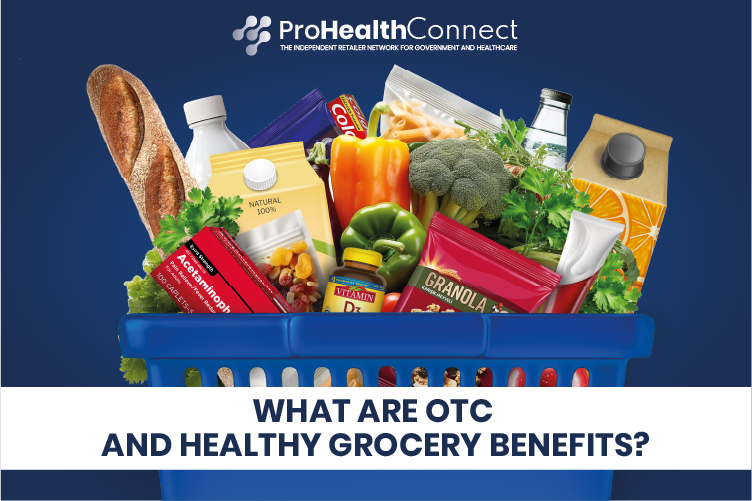
OTC and healthy food benefits are often discussed as supplemental offerings, but the current environment gives them a more serious role. As SNAP becomes less reachable for some households, these benefits can carry more weight as practical supports that help people afford everyday necessities.
That does not mean they replace SNAP. They do not. But it does mean their value increases when other forms of assistance become less reliable, less generous, or harder to access. Healthy grocery benefits in this new reality carry a greater weight; becoming not just a nice-to-haves, but a lifeline that people depend on.
One of the clearest points in the SNAP data is that formal program availability and real-world access are not the same thing. The source article says policies aimed at lowering error rates are likely to cause eligible households to lose food assistance because of administrative burdens. It also points to more frequent verification requirements, delays, and wrongly denied or delayed benefits that are not even counted as errors in the current framework.
From our perspective, this matters well beyond SNAP itself. An OTC or healthy food benefit may be formally present, but if the value is too small, the coverage too narrow, or the redemption process is too confusing, its practical support value may still be limited at the household level.
This is where the strategic implication becomes clearer for benefit designers.
If food assistance pressure is rising, then supplemental benefits need to be evaluated with more seriousness. Three questions matter in particular:
Those questions are not just member-experience questions. They are design questions. In a tighter food-access environment, shallow benefits risk becoming symbolically present but practically weak.
Plans have an opportunity to think more clearly about what their supplemental benefits are really doing.
If OTC and healthy food benefits are treated as low-stakes add-ons, their design may remain narrow, underpowered, or operationally awkward. But if they are understood as part of a member’s practical access to food and everyday health supports, the design standard changes. From our perspective, dollars, usability, and redemption clarity are what matters.
That does not require abandoning discipline in benefit design. It means recognizing that real benefit value is measured not only by what is authorized, but by what a member can actually use.
The SNAP trend should be read as a signal. When public food assistance contracts, the practical importance of other support channels rises.
For health benefit designers, that raises a strategic question: are OTC and healthy food benefits being designed as marginal perks, or as meaningful supports that can hold up in a more financially pressured environment?
The answer will matter more as food-access strain increases. Plans that offer broader, more valuable, and more usable benefits may be better positioned to deliver real support in the moments when members need it most.
As SNAP availability tightens, OTC and healthy food benefits become more important as practical food-access supports. For benefit designers, that means supplemental benefits should be judged not only by how attractive they are on a brochure, but how they affect the calculus in their member’s decisions. We encourage all health plans to offer a benefit that is meaningful to their members and to build a network that makes it available to all.





.png)